


MASSBIOME TECHNOLOGY
Oxford Nanopore R10.4.1 chemistry and long-read sequencing technology are powered by the MASSBIOME software developed by Massive Bioinformatics.
DNA Isolation and Preparation
The most critical source of error in microbiome analyses is the shift in bacterial populations that occurs between sample collection and arrival at the laboratory (Blooming Effect). MassBiome uses a validated proprietary chemical stabilization method to eliminate this risk.
The MassBiome process begins with the extraction of high-purity microbial DNA from fecal samples. The methodology employed efficiently removes PCR inhibitors (e.g., humic acid), ensuring sequencing success.
Wet Laboratory Protocol
- Mechanical Lysis: Effective disruption of gram-positive bacteria and tough cell walls using BashingBead Lysis Tubes.
- Isolation Kit: High-yield DNA extraction using the Quick-DNA Fecal/Soil Microbe DNA Miniprep Kit (Zymo Research).
- PCR Amplification: Error-free amplification using Mobiomx 2x HiFi Taq Master Mix.
16S V1-V9 Full Length
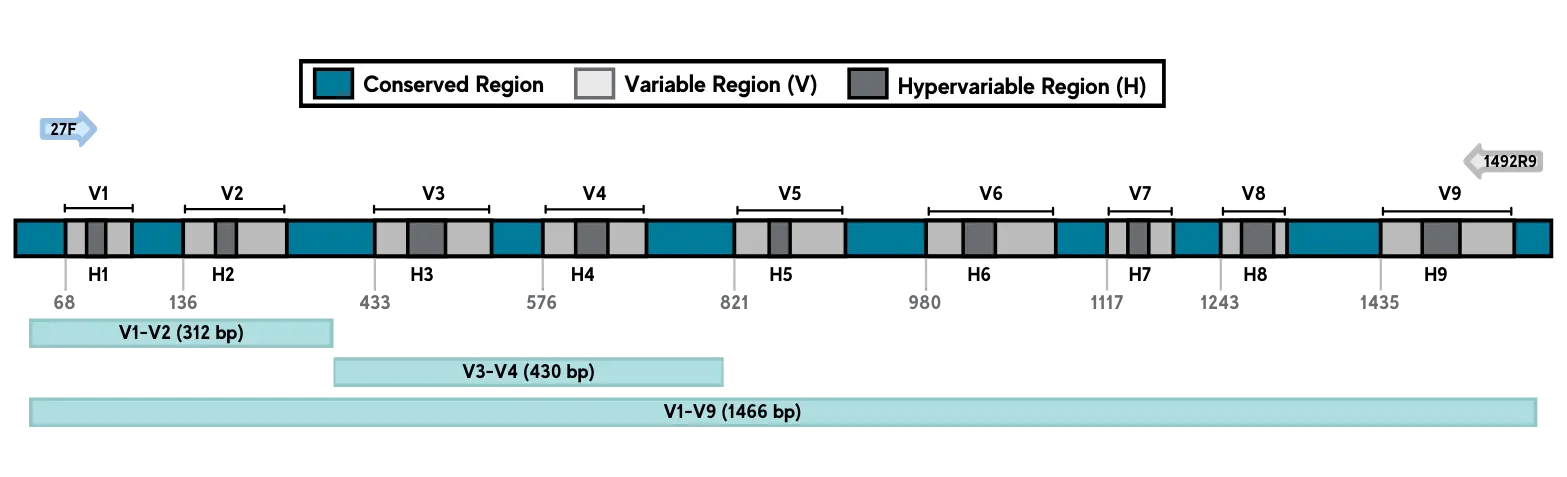
While conventional methods (Illumina, etc.) target only short regions of the 16S gene such as V3-V4 (~400-500 bp), MassBiome technology reads the entire gene (~1,466 bp) in a single read. This enables definitive identification at the "Species" level, rather than stopping at the "Genus" level.
| FEATURE | Conventional Methods (V3-V4) | MassBiome (V1-V9 Full Length) |
|---|---|---|
| Read Length | ~460 Base Pairs (bp) | ~1500 Base Pairs (bp) |
| Identification Level | Typically Genus level | Species level |
| Primer Set | Standard V3-V4 | LR-Primer-16S V1-V9 |
| Phylogenetic Resolution | Low | High (All variable regions included) |
Oxford Nanopore R10.4.1 CHEMISTRY
Amplicons are barcoded, pooled together, and processed on Oxford Nanopore's latest-generation flow cells (R10.4.1 Flow Cell). This technology determines the base sequence by directly reading the changes in electrical current produced as DNA molecules pass through nanopores.
Q20+ Chemistry
With the latest R10.4.1 pore version and V14 kit chemistry (SQK-NBD114.96), raw read accuracy exceeding 99% is achieved.
Real-Time Data
The MinION device generates data while sequencing is in progress (Real-time Basecalling), reducing analysis time to hours rather than days.
MASSBIOME BIOINFORMATICS WORKFLOW
Raw FastQ data is processed through a custom Snakemake-based bioinformatics pipeline. This process is fully automated and minimizes human error.
In this process:
- Length and quality filters are applied,
- Low-quality and off-target reads are discarded,
- Species-level taxonomy assignment is performed using the comprehensive 16S reference database built by Massive Bioinformatics,
- Abundance values are normalized by accounting for 16S copy number variation across different species,
- Alpha diversity, Firmicutes/Bacteroidetes ratio, functional groups, probiotic- and vitamin-associated bacteria, pathogens, and biomarker bacteria are calculated,
- Microbiome similarity/distance profiles for more than 22 diseases are generated using machine learning models trained on tens of thousands of patient and healthy samples.
QUALITY CONTROL
QC & FILTERING
Q-Score > 15 & Length Filter > 1000
SPECIES LEVEL
taxonomy
Alignment to MassBiome Reference Set
PROFILES
CALCULATIONS
Functional Groups, Probiotics, etc.
PRODUCT
REPORTING
Microbiota Analysis Report
Reporting and Machine Learning
The strength of MassBiome reports lies in analyzing patient data not in isolation, but comparatively against a "Reference Cohort" of 10,000+ healthy individuals.
The resulting taxonomic profile is compared against MassBiome's database of 10,000+ healthy individuals. The report output includes not only bacterial names but also their clinical significance.
- Microbiome diversity and F/B ratio,
- Enterotype (microbiome type),
- Functional bacterial groups and vitamin-associated bacteria,
- Pathogens and biomarker bacteria,
- Disease susceptibility/protection patterns,
- Mood-related risk profile,
- Personalized nutrition, probiotic, and supplement recommendations
among others. In this way, MassBiome transforms laboratory data from a purely technical output into a tangible, actionable clinical decision support tool for physicians and end users alike.
frequently asked questions
Why do you use Oxford Nanopore V1-V9 instead of Illumina V3-V4?
The 16S ribosomal region is the 30S subunit of the prokaryotic ribosome. This gene region is one of the most frequently used in targeted metagenomic sequencing for archaea and bacteria. 16S rRNA genes typically contain nine "hypervariable regions" that exhibit significant sequence differences between species and can be used for species identification. Based on differences in ribosomal RNA sequences, the composition of the microbiome and the relative abundance of species can be revealed.
Standard V3-V4 analysis reads only a short ~450-base region of the 16S gene and typically identifies organisms only at the "Genus" level. MassBiome, on the other hand, reads the entire ~1,500-base gene (Full-Length), enabling definitive identification at the "Species" level — and in some cases, at the subspecies level. For example, only this technology allows you to distinguish E. coli from its harmless relatives.
Which Oxford Nanopore devices is MassBiome compatible with?
MassBiome is fully compatible with .pod5 and .fastq data generated from MinION (Mk1B/Mk1C/Mk1D), GridION, and PromethION devices.
Isn't the error rate of Nanopore technology high?
This was true for older Nanopore versions; however, with our current R10.4.1 flow cells and Q20+ V14 Chemistry, raw read accuracy has surpassed 99% (Q20 score). Furthermore, AI-assisted correction algorithms in our bioinformatics pipeline bring this rate up to clinical standards.
What is the turnaround time?
After the sample arrives at the laboratory, the processes of DNA isolation, library preparation, and sequencing take a combined total of 24-48 hours. Bioinformatics analysis and reporting are completed within an average of 2-4 hours from data upload, thanks to our automated system. Results can be delivered within a total of 3 business days.
Is on-premise installation possible?
Yes. MassBiome was designed with exactly this vision in mind — to enable institutions with data sovereignty requirements to generate value from their own data within their own premises. For this reason, the system was designed entirely as an in-house solution. When you choose to install MassBiome in your laboratory, your needs will be met with a high-performance MassBiome workstation provided by Massive Bioinformatics.
Can I request a demonstration before installing the system?
Absolutely. As Massive Bioinformatics, we understand how heavily high investment costs weigh on institutions. That is why we are confident in the return on your investment and can support your institution with the most suitable demonstration formats available.
How do you ensure sample integrity?
A preservative solution is essential to ensure sample integrity throughout local logistics processes. We have conducted extensive studies on sample preservation, and a detailed report on the "Preservative Solution Stability Analysis" is included as an attachment.
How long can samples truly remain stable at room temperature? Is a cold chain (ice pack) required?
The MassBiome stabilization solution is formulated to preserve DNA/RNA integrity at room temperature (+20°C to +25°C) for up to 4 weeks. Ice packs or dry ice are not required, thereby reducing your logistics costs. In our validation studies, 99% taxonomic similarity was achieved even on Day 28 compared to "Day 0" (fresh sample).
How many samples can I run with a single Flow Cell?
With the R10.4.1 Flow Cell capacity and our barcoding kits, you can run 12 to 96 samples simultaneously (multiplexing) in a single run. The recommended optimal number, when evaluated in terms of investment cost and cost-to-performance ratio, is typically 24 or 48. As the number of samples increases, your per-sample cost decreases.
Does the kit include all consumables needed for DNA isolation?
Yes. The MassBiome Kit includes all necessary biochemicals following a "Sample-to-Result" philosophy — encompassing Zymo Research fecal DNA isolation kits, Mobiomx V1-V9 primers, PCR master mix, ligation enzymes, and barcoding kits. You will only additionally need standard laboratory consumables (pipette tips, ethanol, etc.).